
Important Notice: Wholesale Clients Only. This material is intended solely for “wholesale clients” as defined under the Corporations Act 2001 (Cth) and is not intended for retail investors.
The global technology landscape is undergoing a profound shift from the era of the “large model arms race” towards the practical deployment of Agentic AI. This paradigm shift is placing greater demands not only on computing power, but also on underlying storage architectures and memory bandwidth. As the global technology sector enters a new wave of AI infrastructure investment, South Korea — a global powerhouse in semiconductors and hardware — is entering a potentially significant phase.
Global financial markets are currently seeing increasingly pronounced supply-demand imbalances and pricing premiums across memory chips. On one hand, upgrades to traditional servers and the expansion of CPU nodes in AI servers are driving demand for DDR5 and LPDDR5. On the other, HBM (High Bandwidth Memory) production capacity has become increasingly constrained, causing advanced memory capacity to crowd out conventional memory production and further tightening the broader memory chip market.
Against this backdrop, the performance and capacity expansion of South Korea’s semiconductor and technology leaders have become an important indicator of the outlook for the global AI industry.
Industry Research: The AI Agent-Driven Memory Upcycle
According to UBS’s latest global research published in June 2026, the drivers of AI-related memory demand are broadening significantly. Demand is no longer concentrated solely in HBM. Agentic AI is also driving unprecedented demand across conventional servers, KV cache applications and multiple layers of storage infrastructure.
- Contract Prices Are Rising Across the Board as Supply Shortages Persist
Supply constraints: Almost all incremental DRAM wafer capacity has been allocated to HBM, while there is virtually no new NAND capacity outside China. As a result, suppliers are struggling to keep pace with the rapid increase in demand.
Price outlook: Industry research indicates that contract prices for DDR and NAND flash memory, excluding long-term agreements (LTAs), are expected to rise by approximately 17% quarter-on-quarter in Q3 2026, followed by a further 12% quarter-on-quarter increase in Q4. UBS expects the blended average selling price (ASP) for DRAM to increase substantially in 2026.
- HBM Pricing Remains Resilient, Reinforcing the Market Position of Industry Leaders
Pricing outlook: Market negotiations for 2027 HBM4E are approaching approximately US$3.50 per Gb, while HBM4 remains close to US$3.00 per Gb. Based on this outlook, UBS has revised its forecast for SK Hynix’s 2027 blended HBM average selling price growth to approximately 62% year-on-year.
Capital expenditure and valuation: Reflecting the strong pricing outlook, UBS raised its 12-month price target for SK Hynix from KRW 2,250,000 to KRW 3,000,000, while maintaining a “Buy” rating. Based on the broader analysis from Nomura and UBS, the strong profitability and cash-flow generation of leading Korean technology companies continue to underpin market pricing.
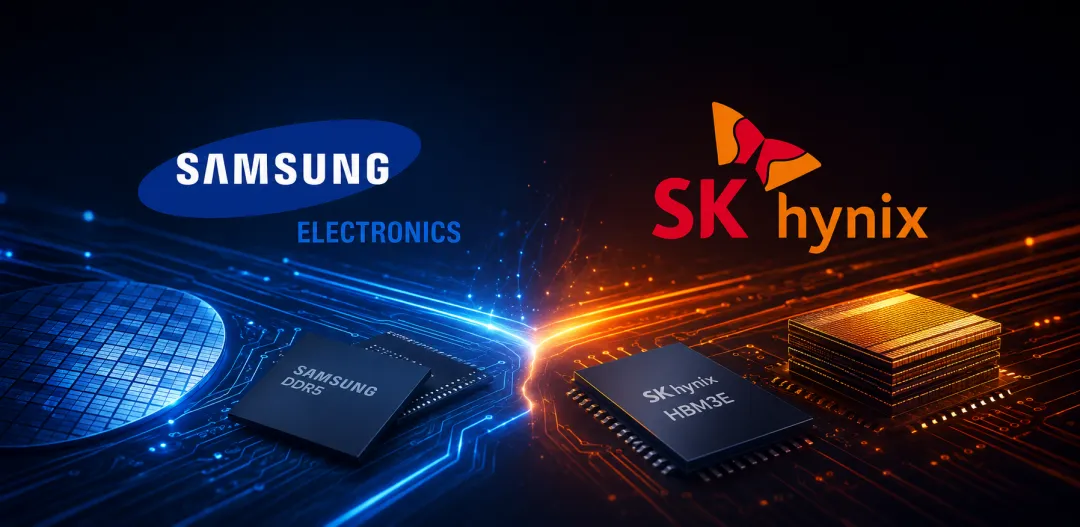
The Investment Case for Korea’s Technology Leaders
Against the strong momentum in the Korean market, we have summarised several key considerations underpinning the investment case:
- Scarcity and competitive barriers of core assets: Samsung Electronics and SK Hynix are two of South Korea’s leading semiconductor companies and account for a significant share of the global advanced memory and HBM markets. As AI applications become increasingly bandwidth-intensive, these companies maintain significant market influence and technological advantages.
- A combination of structural technology growth and cyclical recovery: South Korea’s technology sector is benefiting not only from the long-term structural expansion of AI, but also from an upcycle in memory-chip pricing and corporate inventory replenishment. In addition, telecommunications and technology groups such as SK Telecom are positioning themselves across AI infrastructure and domestic services while maintaining established cash-flow-generating businesses.
- Potential valuation recovery with structural earnings growth: While relevant equities have already recorded gains, the latest brokerage earnings forecasts suggest that improvements in structural ROE may not yet be fully reflected in current P/B valuations. Structured products may provide an alternative means of gaining exposure to the sector while incorporating a predefined downside buffer.
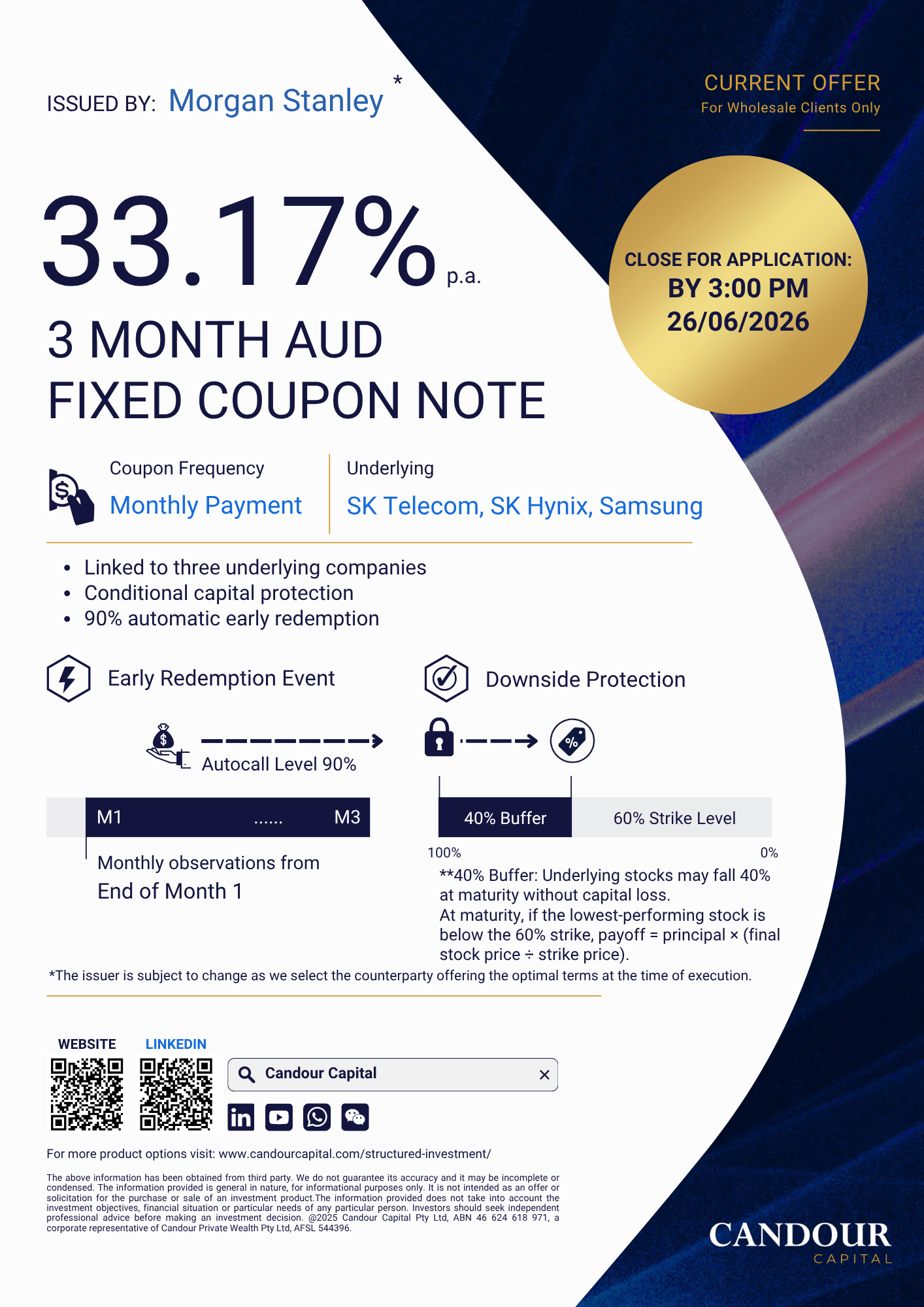
Selected Investment Opportunity: AUD 3-Month 33.17% p.a. Fixed Coupon Note (FCN)
Addressing access barriers through a structured solution: South Korea maintains relatively stringent regulatory requirements for foreign investors, which can make direct investment in Korean domestic equities operationally complex. A carefully structured product may provide an alternative way for eligible investors to obtain exposure to selected Korean technology leaders without directly purchasing the underlying shares.
The key terms of the FCN are:
- Underlyings: SK Telecom, SK Hynix and Samsung Electronics
- Product: Fixed Coupon Note (FCN)
- Currency: AUD
- Tenor: 3 months
- Strike Level: 60%
- Potential Annualised Coupon: 33.17% p.a.
Key Features of the Strategy
This product provides exposure to three leading Korean technology and semiconductor companies.
With a 60% strike level, the structure incorporates a 40% downside buffer relative to the initial reference level. At the same time, the elevated implied volatility and market pricing of Korean equities support a potential annualised coupon of 33.17% p.a. in AUD.
The structure is designed to convert elevated market volatility into a predefined coupon opportunity. However, the coupon should not be interpreted as a guaranteed total investment return, and investors remain exposed to the performance of the underlying shares and the terms of the note.
Further Information
As the AI investment cycle continues to develop, structured products may provide eligible investors with an alternative way to obtain exposure to selected themes while incorporating predefined investment terms.
If you would like further information regarding the product mechanics, underlying equities, key risks or subscription process, please contact your Candour Capital adviser for the relevant product materials and further details.