
Important Notice: Wholesale Investors Only. This material is intended solely for “wholesale clients” as defined under the Corporations Act 2001 (Cth) and is not intended for retail investors.
As the end of the financial year approaches, many investors begin to focus on two key considerations:
- How to undertake appropriate End of Financial Year tax planning;
- How to position for investment themes with growth potential in the coming financial year.
Against this backdrop, Candour is presenting an illustrative 100% capital-protected loan structure, designed to enable eligible wholesale investors to prepay interest on an investment loan while gaining potential exposure to selected U.S. technology and semiconductor themes.
Key features of the illustrative structure include:
- 100% capital-protected loan structure
- Investors prepay the interest on the investment loan at inception
- Prepaid interest may be eligible for a tax deduction, subject to individual circumstances
- Exposure to selected U.S. technology and semiconductor ETFs
- Potential participation in upside returns if the relevant assets meet specified conditions
- Other eligible underlying assets may also be considered depending on investor requirements
Investors should consult their accountant or tax adviser regarding the tax treatment of prepaid investment loan interest.

Why Consider This Structure Before End of Financial Year?
Ahead of the end of the financial year, some investors may consider tax planning strategies involving the prepayment of interest on an investment loan.
Under this structure, investors pay the investment loan interest upfront when the investment commences. For eligible investors, prepaid interest may potentially be claimed as a tax deduction.
However, the specific tax treatment depends on each investor’s individual circumstances, including the purpose of the investment, income structure, entity type, funding arrangements and holding structure. Investors should therefore consult their accountant or tax adviser before participating to determine whether the arrangement is appropriate and whether the prepaid interest may be deductible.
In this sense, the structure provides not only an investment participation opportunity but may also serve as one consideration within broader End of Financial Year tax planning.
What Does a 100% Capital-Protected Loan Structure Mean?
Under a 100% capital-protected loan arrangement, investors are provided with financing corresponding to the relevant investment amount.
Unlike a conventional investment loan, investors are not required to contribute the investment principal upfront. The primary cash outlay at inception is the prepaid interest on the investment loan.
At maturity, the loan principal is generally repaid through the operation of the structure. Accordingly, the investor’s primary economic cost is concentrated in the prepaid interest paid at inception rather than the full notional investment principal.
If the underlying asset performs above the specified level, the investor may participate in the applicable upside return. If the underlying asset does not satisfy the conditions required to generate an upside return, the prepaid interest already paid is not refunded.
From an investor’s perspective, the structure provides potential participation in the upside of the selected underlying assets through the payment of prepaid loan interest, while the loan principal is subject to a 100% capital protection arrangement.
Illustrative Terms
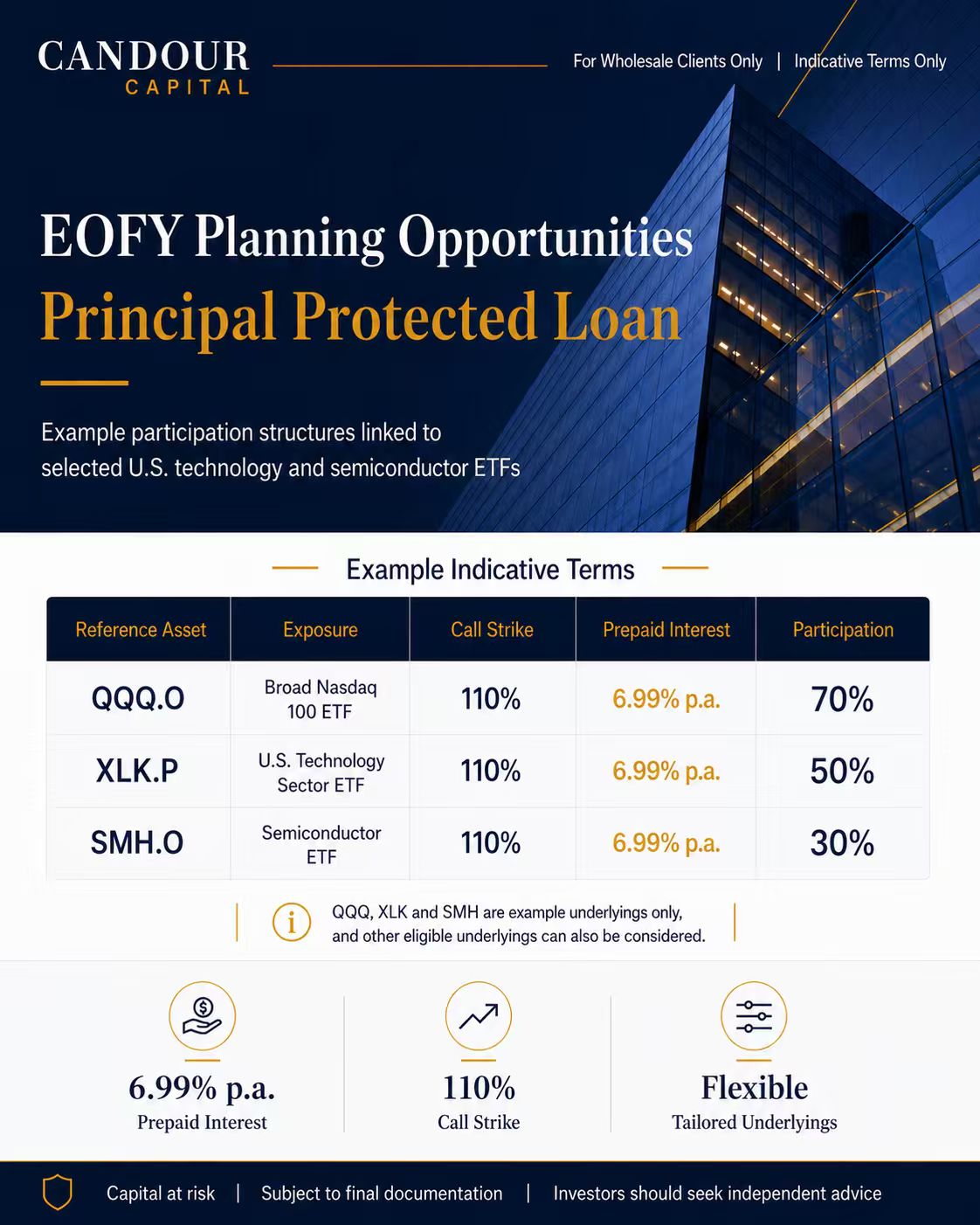
The following terms are provided for discussion and illustration purposes only:
| Reference Asset | Investment Theme | Term | Strike Price | Prepaid Interest | Indicative Participation Rate |
| QQQ.O | Nasdaq-100 ETF | 12 months | 110% | 6.99% p.a. | 70% |
| XLK.P | U.S. Technology Sector ETF | 12 months | 110% | 6.99% p.a. | 50% |
| SMH.O | Semiconductor ETF | 12 months | 110% | 6.99% p.a. | 30% |
These terms are illustrative only. Final terms will be subject to actual pricing and formal product documentation. Other eligible underlying assets may also be considered depending on investor requirements.
How Are Returns Generated?
The return mechanism is relatively straightforward.
If the selected ETF finishes above the 110% strike price at maturity, the investor may participate in the return above the strike level according to the applicable participation rate.
For example, if QQQ increases by 25% over the term, the relevant upside would be calculated based on the portion above the 110% strike level and then multiplied by the 70% participation rate.
If the selected ETF does not exceed the strike price at maturity, no upside return will be generated, and the prepaid investment loan interest will not be refunded.
Why U.S. Technology and Semiconductor ETFs?
U.S. technology and semiconductors remain important investment themes for global investors, particularly against the backdrop of continued market attention on artificial intelligence, cloud computing, semiconductor demand and the profitability of major technology companies.
This illustrative structure provides three potential areas of exposure:
QQQ — Broader U.S. large-cap growth exposure. QQQ provides exposure to major growth companies within the Nasdaq-100 Index and offers relatively diversified participation in the performance of large U.S. technology and growth companies.
XLK — More concentrated U.S. technology exposure. XLK is primarily focused on large U.S. technology companies and may be relevant to investors seeking more targeted exposure to the U.S. technology sector.
SMH — Semiconductor and AI hardware exposure. SMH focuses on the semiconductor value chain and provides more thematic exposure for investors interested in chips, AI infrastructure and semiconductor-related applications.
Who May Wish to Explore This Structure Further?
This structure may be relevant for wholesale investors who:
- are currently considering End of Financial Year tax planning arrangements;
- are comfortable prepaying investment loan interest before the End of Financial Year;
- wish to discuss the potential deductibility of prepaid interest with their accountant;
- have a constructive 12-month view on U.S. technology or semiconductor sectors;
- are interested in accessing an investment opportunity through a 100% capital-protected loan structure; and
- understand that if the underlying asset does not exceed the strike price, the prepaid investment loan interest will not be refunded.
End of Financial Year is often an important time for investors to review both tax planning and portfolio positioning. For wholesale investors considering prepaid investment loan interest while also seeking potential exposure to U.S. technology and semiconductor themes, this 100% capital-protected loan structure may warrant further consideration.
Investors should assess the structure considering their individual circumstances and discuss its suitability for tax planning purposes with their accountant or tax adviser.
Important Information
This material is intended for wholesale clients only and is provided for general information and discussion purposes. It does not constitute investment, tax or legal advice, nor does it constitute an investment recommendation.
Whether prepaid investment loan interest is deductible depends on each investor’s individual circumstances. Investors should seek independent tax advice from their accountant or tax adviser before participating and confirm the applicable tax treatment.
If the selected underlying asset does not exceed the relevant strike price at maturity, no upside return will be generated, and the prepaid investment loan interest will not be refunded. Final terms are subject to formal product documentation.
For further information regarding the subscription process or to obtain the complete product documentation, please contact Candour Capital.