
HSBC recently announced the phased discontinuation of its retail banking operations in Australia. As many high-net-worth investors have historically invested in bonds through HSBC Australia’s wealth management services, we have summarised the potential implications of these changes for bond investors and outlined some key considerations.
HSBC has announced that it will cease providing wealth management services to high-net-worth investors and plans to stop acting as investment adviser for the relevant investment accounts from 16 November 2026.
Existing bonds will not be automatically sold as a result of this change, nor will the relevant accounts automatically close on that date. However, the investment advice, transaction support and account services previously provided through HSBC will change. Investors will therefore need to consider how their existing bond holdings will be managed, whether they wish to continue investing in new bonds, and who will provide the relevant services going forward.
■ What Changes Is HSBC Making?
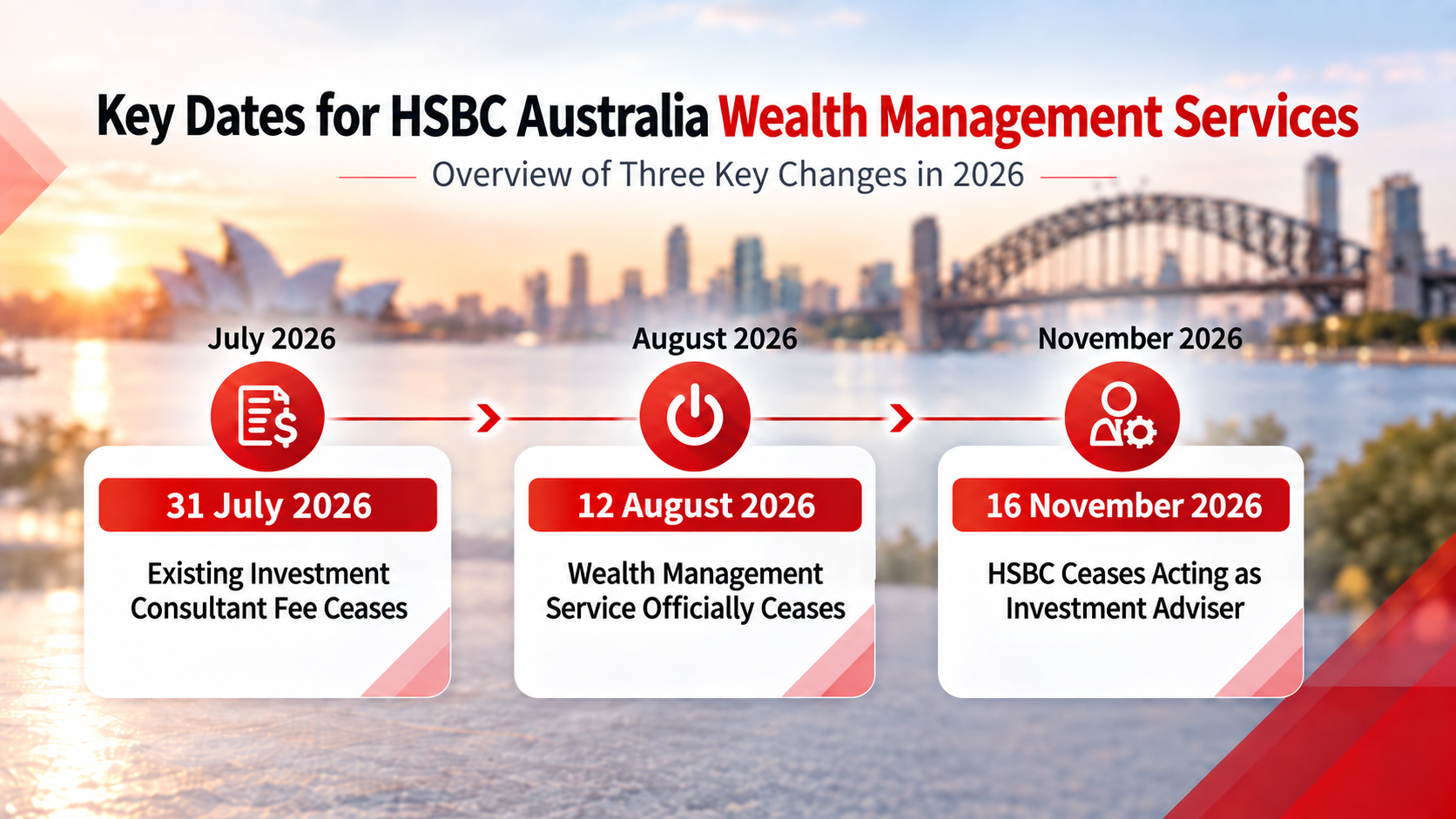
On 31 July 2026, HSBC Australia announced the phased discontinuation of its Australian retail banking operations.
For clients using the HSBC Investment Service for Accredited Investors, HSBC’s wealth management service for high-net-worth investors, a more specific transition timetable applies.
From 31 July 2026, HSBC ceased charging the existing Investment Consultant Fee.
From 12 August 2026, the wealth management service formally ceased. Clients can no longer purchase new investment products through the existing service or continue receiving HSBC’s investment research, market views and general investment recommendations. During the transition period, HSBC will continue to provide certain support for existing investments, including assisting clients in accessing investment reports and facilitating the sale of existing investments before accounts formally transition to self-directed status.
On 16 November 2026, HSBC will cease acting as investment adviser for the relevant Netwealth accounts. Unless clients have appointed a new adviser before then, their accounts will transition to a self-directed arrangement, under which they will be responsible for their own investment decisions and account management.
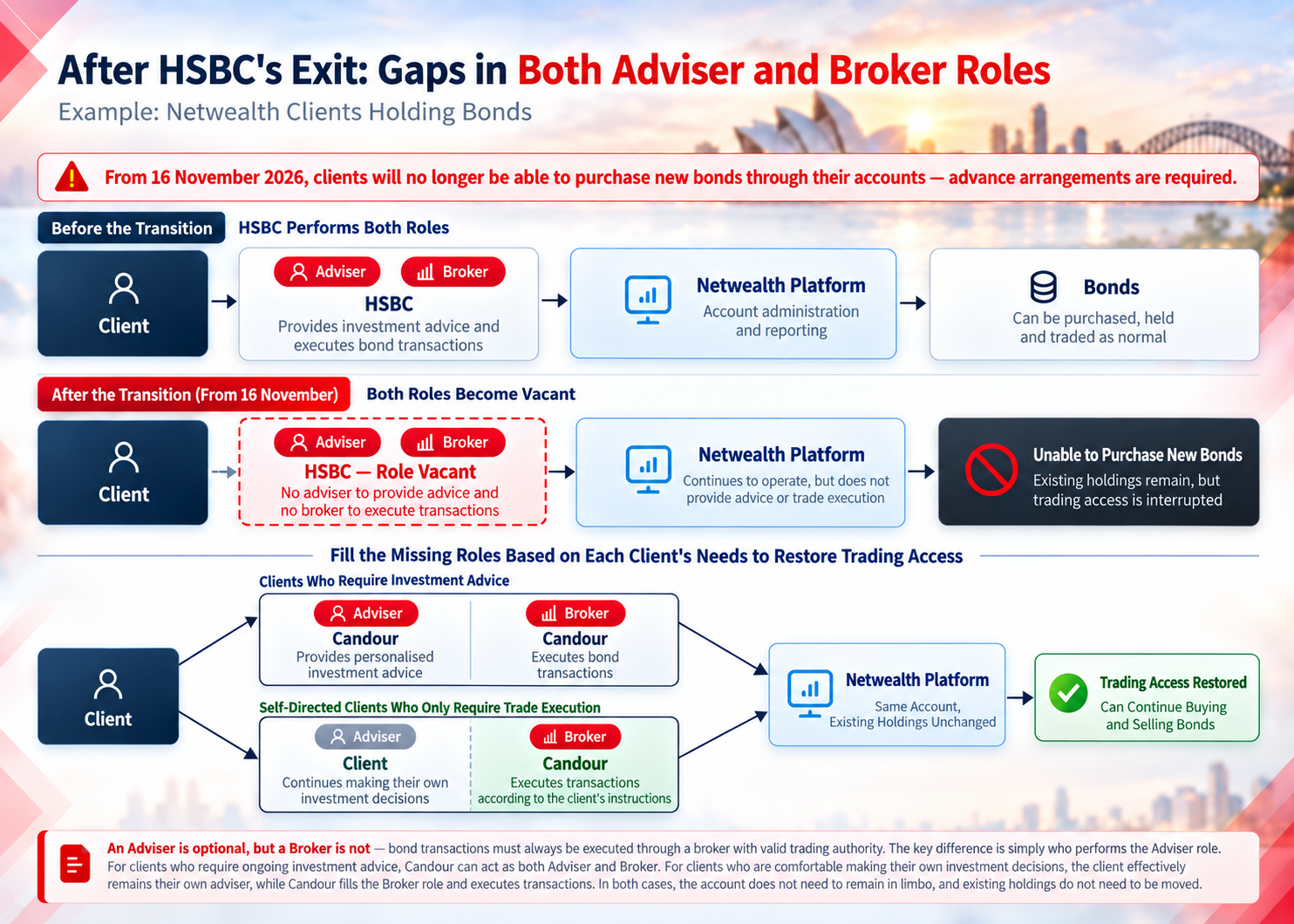
HSBC has also stated that, once an account becomes self-directed, clients will no longer be able to purchase new bonds through that account.
■ Why is Netwealth involved?
Many of HSBC’s high-net-worth clients previously received wealth management and bond investment services through HSBC, while the associated investment accounts were supported by the Netwealth platform, which provided account administration and asset custody.
Under this arrangement, HSBC was primarily responsible for the client relationship, investment advice and related services. Netwealth, meanwhile, operated as the investment and custody platform, holding and recording client assets, administering investment accounts and processing transaction settlements.
When HSBC ceases acting as investment adviser, the existing advisory relationship will end. However, the relevant Netwealth accounts and bonds held within those accounts can remain in place.
Netwealth will continue to provide account administration, custody and execution of client instructions in accordance with the permissions applicable to each account. It will not, however, replace HSBC as the investment adviser or manage the client’s portfolio on the client’s behalf.
As a result, after 16 November, clients will need to decide whether to continue managing their accounts on a self-directed basis or appoint a new investment adviser.
■ What Are the Two Options After 16 November?
Before HSBC ceases acting as investment adviser for the relevant investment accounts on 16 November 2026, clients will need to decide how they wish to manage their investments going forward.
Broadly, there are two options: retain the existing account and manage investments on a self-directed basis, or appoint a new investment adviser and continue receiving investment advice and account management support.
The key differences relate to who is responsible for investment decisions and whether the client will continue to have access to professional investment advice and bond transaction support.
Option 1: Retain the Account and Manage Investments Independently
Clients who choose the self-directed option may retain their existing account, review their holdings, manage the account and take permitted actions through the platform.
Investment decisions will become the client’s responsibility. This includes deciding whether to continue holding existing bonds, when to sell them, how to manage proceeds when bonds mature, and whether the overall portfolio needs to be adjusted.
Clients will also need to monitor maturity dates, coupon payments, market prices and issuer developments themselves.
Importantly, HSBC has confirmed that self-directed clients will not be able to purchase new bonds through the existing account. Clients choosing this option may therefore continue managing their existing investments but will not be able to add new bond investments through the account in the same way as before.
If they wish to purchase bonds in the future, they will need to use another bond trading channel.
Option 2: Appoint a New Investment Adviser
Clients who wish to appoint a new investment adviser will need to make the relevant arrangements before 16 November.
A new adviser can continue to assist with portfolio reviews, investment recommendations, future investment planning and account management.
Clients should consider selecting an adviser familiar with fixed-income investments, particularly the Australian and international bond markets, bond maturity arrangements and transaction processes. The new adviser will also need to understand the client’s existing account structure and bond holdings to assist with the ongoing holding, sale, reinvestment and transition of those assets.
After appointing a new adviser, clients may continue to receive professional investment support. However, the scope of services and fee arrangements will be determined by the new adviser.
HSBC’s existing research, recommendations and advisory services will not automatically transfer to the new adviser. Clients will need to confirm the scope of services, investment authorities and future transaction arrangements with their newly appointed adviser.
■ What Should Clients Do With Their Existing Bonds?
HSBC has not indicated that existing bonds will be automatically sold on 16 November.
There is therefore no need for clients to sell their bonds simply because the existing advisory relationship is coming to an end. A more important first step is to understand what they currently hold, when each bond matures and whether they intend to continue allocating to bonds in the future.
For each existing bond, investors should consider confirming the issuer, maturity date, coupon, currency, current market price and the account in which it is held. Bonds approaching maturity within the next one to two years may warrant particular attention, as investors will need to determine how the proceeds will be managed or reinvested.
Clients considering selling a bond before maturity should also determine who will provide future market pricing and execute the transaction.
Unlike listed shares, many bonds are traded through brokers or other market intermediaries, with investors obtaining a quote before executing a purchase or sale. The future trading channel is therefore another important aspect of the transition that needs to be clarified.
■ What Can Clients Start Doing Now?
There is still time to prepare before 16 November.
Clients can begin by reviewing their existing accounts and bond investments and confirming which bonds they currently hold, when those bonds mature, and whether they expect to continue investing in bonds in the future.
It is also worth considering whether they are comfortable managing future investment decisions independently or would prefer to continue receiving professional investment advice and support.
The choice between these arrangements can affect how the account operates, the investment options available and how future transactions can be executed.
Clients who remain uncertain about their existing account, bond holdings or future options may wish to seek clarification from the relevant service providers as early as possible and, where appropriate, obtain confirmation in writing rather than leaving these arrangements until close to the transition date.
■ How Can Candour Assist?
Candour is continuing to monitor the account and bond arrangements arising from HSBC’s wealth management service changes and is confirming the operational details with the relevant service providers.
If you currently hold bonds through HSBC or are considering your arrangements after 16 November, we can assist you in reviewing your existing account and bond holdings, explaining the differences between self-directed investing and appointing a new adviser, and providing information regarding the relevant transaction, account and service arrangements.
For clients requiring further transition support, we can also discuss appropriate service arrangements based on their circumstances.
Certain matters — including whether former HSBC clients who transition to self-directed investing will be able to continue trading bonds through an independent broker, as well as the relevant broker eligibility requirements and settlement processes — remain subject to further confirmation from Netwealth. Candour is continuing to verify these operational details.
■ Key Takeaway
HSBC’s wealth management services are now in a transition period. For high-net-worth clients who previously invested in bonds through HSBC, their existing bonds and accounts can remain in place, but the existing advisory and service arrangements will change.
After 16 November, clients may either manage their investments on a self-directed basis or appoint a new investment adviser. The two arrangements differ in terms of investment support, access to bond transactions and the way accounts are managed.
The most practical step at this stage is to review existing bond holdings and account information, determine whether bond investing and professional advice will still be required in the future, and understand in advance the account and transaction arrangements associated with each option.
Sources, Information Date and General Information Disclaimer
This article has been prepared based on publicly available information published by HSBC Australia regarding the transition of its wealth management services for high-net-worth investors, together with relevant publicly available information from Netwealth. Information is current as at 11 September 2026.
This article is provided for general information and investor education purposes only and does not constitute personal financial, legal or tax advice. Account arrangements, investments, eligibility and service arrangements may vary between clients. Before taking any action, investors should consider their individual circumstances and confirm the latest arrangements with the relevant service providers and professional advisers.